[ 05 · Thesis · LABA Firenze · start-up · 2023 ]
Binder
Volleyball NFT cards and a fantasy league, pitched for $2.5M to $4M.
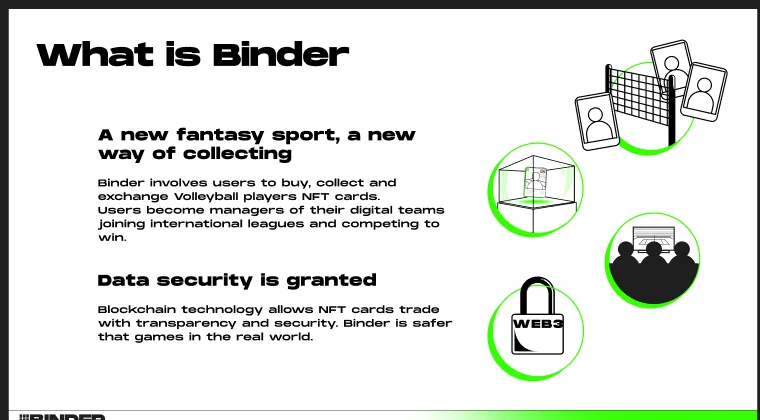
Binder turns volleyball players into NFT cards you line up like a fantasy team, then puts one in your hand through a phone camera. I designed the product and the pitch.
- Role
- Founder · Product Designer · 3D
- Year
- 2023
- Tags
- AR · Web3 · Pitch
[ 01 · Context ]
Binder started as my BA thesis at LABA Firenze in 2023 and carried on as a start-up. Volleyball has a big young audience, 600 million people across 21 countries by the deck's own figure, and almost nothing to collect between matches. Panini did it on paper for generations; we wanted a card you could actually play with.
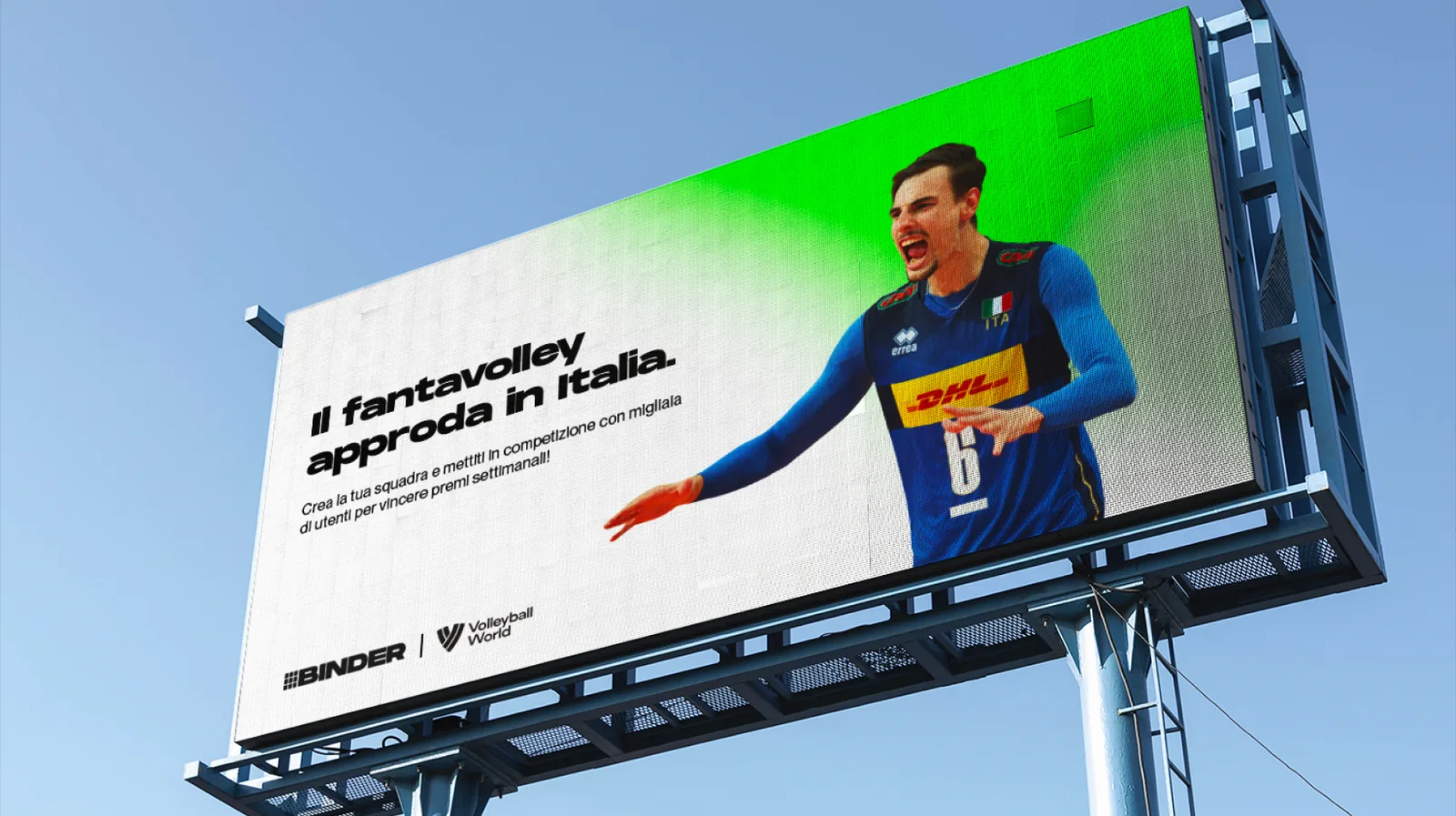
There were four of us. We pitched the CEO of Volleyball World and raised nothing, so the co-branded billboard in these images is a mock-up of a campaign that never ran.
[ 02 · Role ]
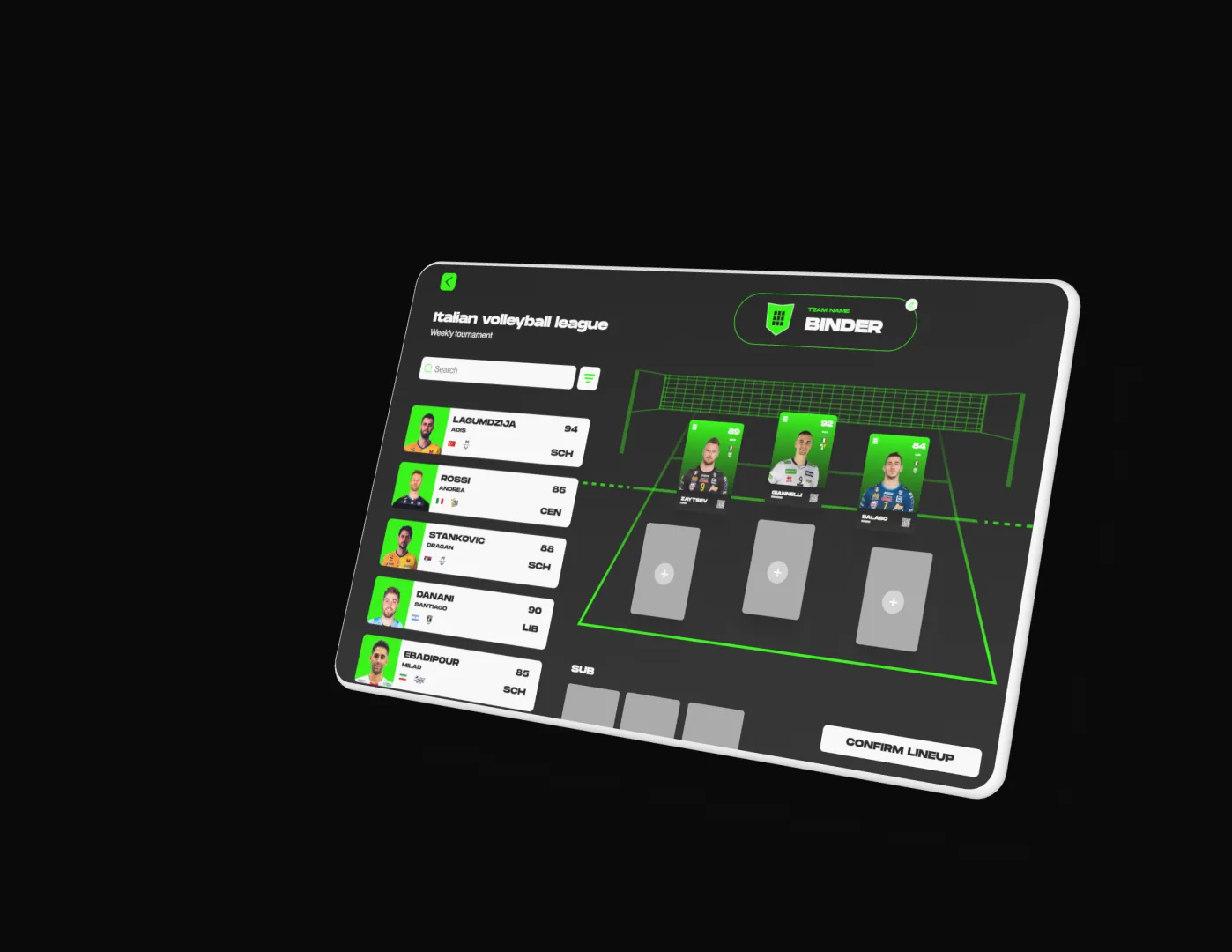
I was the founder and the product designer. I drew the flow, the card system, the dApp screens and the pitch deck, and modelled the 3D cards in Spline myself. An external 3D artist took the AR build from my brief.
I did not build the platform. We were still raising the money to start development.
[ 03 · Problem ]
A fan's relationship with the sport runs one way. You watch, you post, you wait for next week. The deck names three gaps: engagement stuck in traditional channels, no tool connecting fans to players, and no way for either side to benefit from that loyalty.
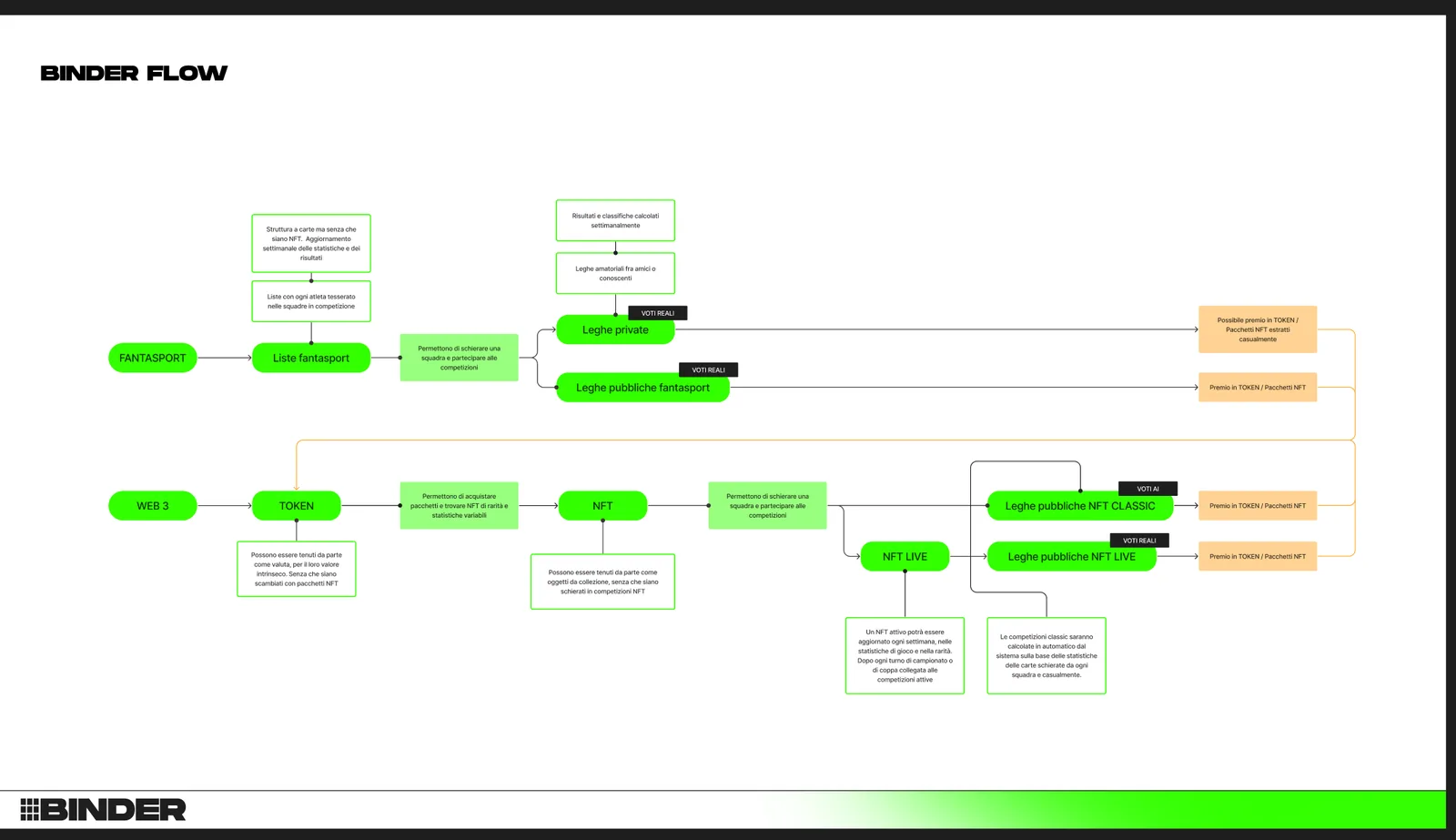
The harder problem was the door. A volleyball fan does not own a wallet and does not want one, so the flow has two entrances that end up in the same leagues: a fantasy game anyone can play, and a web3 track of tokens, packs and cards for people who already hold one.
[ 04 · Decisions ]
- 01
3D cards in Spline, not flat artwork
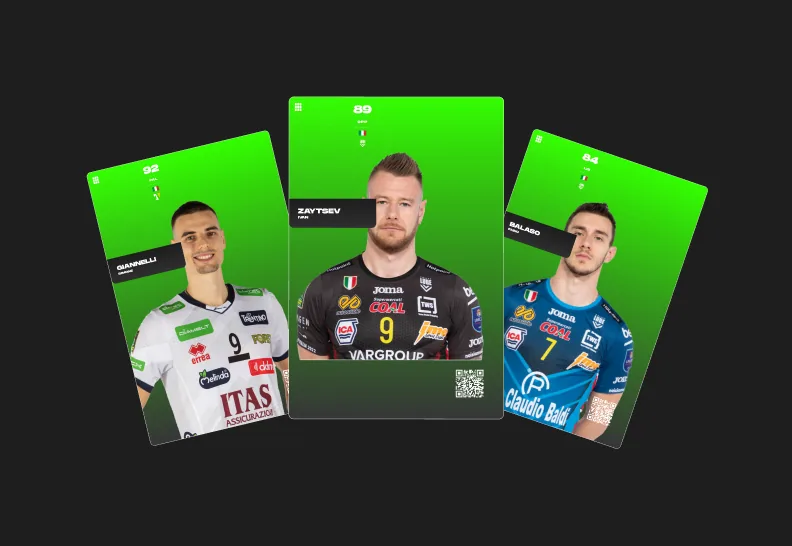
I modelled the cards in Spline so they could turn and catch light. A flat image on a phone reads as a screenshot; a card you can rotate reads as something you own. The cost is real: every card needs 3D work, so a full league season is slow to produce. For a pitch I needed three convincing cards, not three hundred.
- 02
AR in the browser off a QR code, not an app
The AR brief asks for one thing: scan a code with the phone camera, land on our subdomain, watch the card rise off it. The code sits on a coaster, so it works in a bar during a match. I gave up tracking quality, persistence and any store presence, and it is mobile-only. Nobody installs an app for a card they do not own yet.
- 03
Binance Smart Chain instead of Ethereum
We chose BSC for the reasons the abstract lists: scalability, security, low transaction costs. A fantasy line-up is many small moves a week, and Ethereum gas on each one can cost more than the card. What we gave up is where the collectors, the marketplaces and the money already were.
[ 05 · Outcome ]
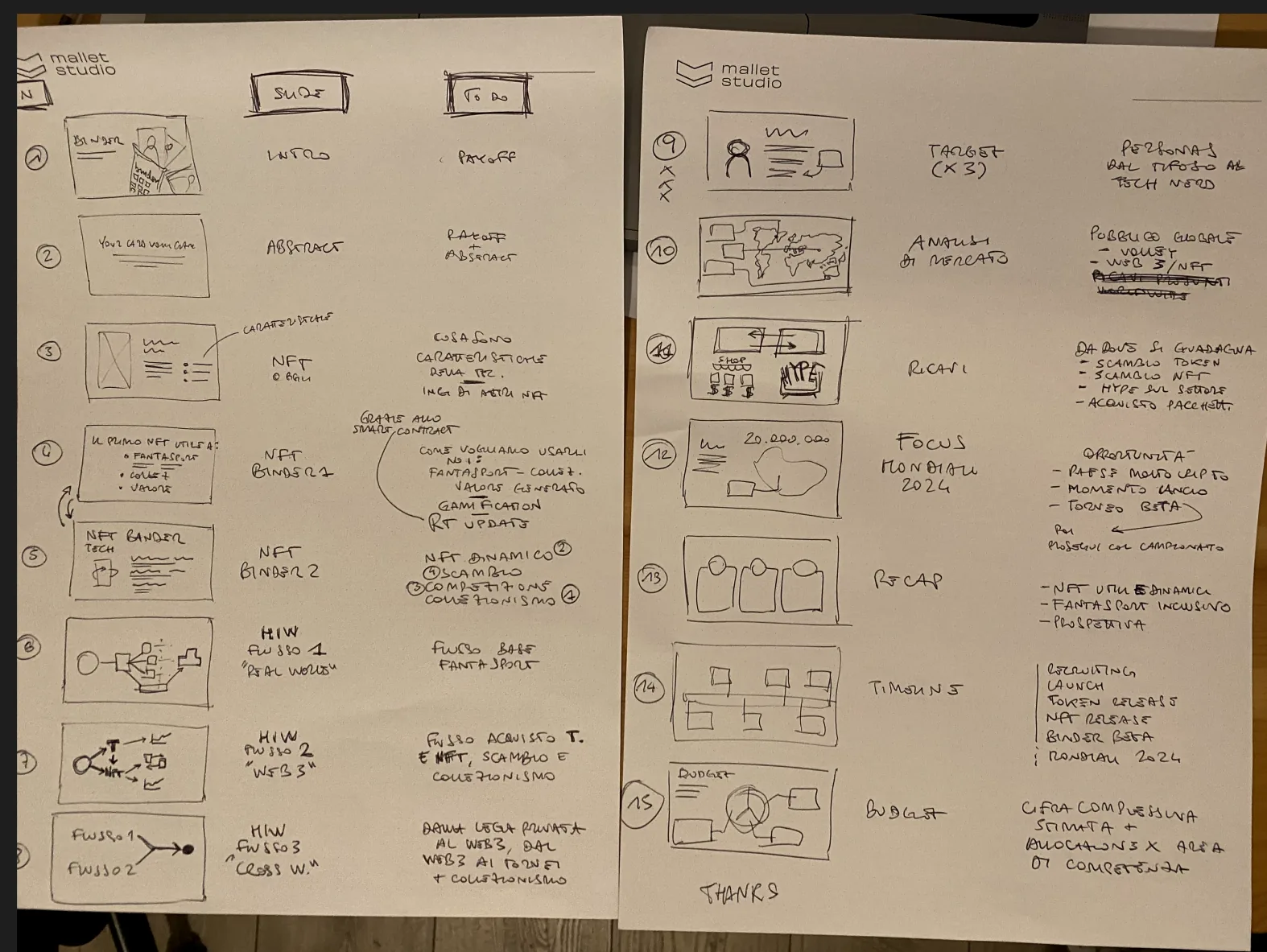
The pitch shipped. Fifteen slides planned by hand on paper became the deck: market, then the product, then a roadmap running kick-off, recruiting, token release, first NFT collection and alpha, ending on a budget slide asking $2.5–4M.
The platform did not. We presented the deck to the CEO of Volleyball World, raised nothing, and development never started. No launch, no users, no revenue: every number in the deck is a market estimate, not ours.
[ 06 · Credits ]
- Federico Vietti — founder, product designer, 3D cards in Spline
- Four people on the deck's team slide: founder, co-founder, developer, 3D artist
- Spline for the 3D cards, Figma for flow, screens and deck, Binance Smart Chain
- AR build briefed out to an external 3D artist
[ Contact ]
Let’s talk
Open to product design roles, and to good collaborations.